Transport on Intermittent Networks

The Timetable Is the Network

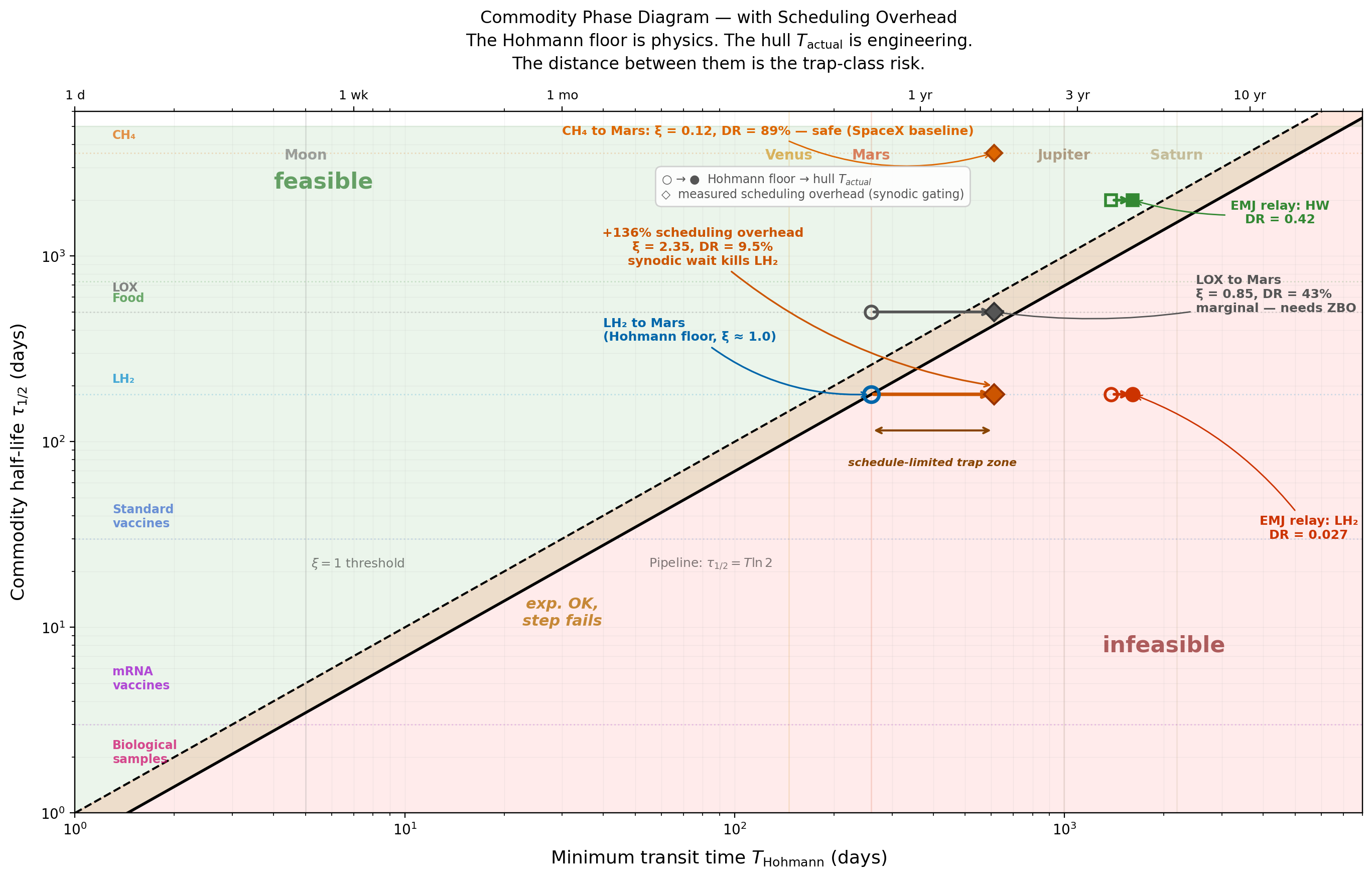
Commodity phase diagram showing feasibility boundaries by cargo half-life and transit time
Your cargo is somewhere on this chart. Where it falls determines whether your mission works.

The Argument

Problem:
Delay-tolerant networks have no rigorous reliability certification method.
Core result:
Deliverability decomposes exactly as DR = ST × η. (Arithmetic identity — true by construction.)
Classification:
The order parameter γ separates temporal contact graphs into two classes (cluster vs. trap) with zero sign overlap across 155,000+ configurations. (Empirical regularity — strong evidence, no proof.)
Applied consequence:
The current cislunar architecture fails certification in the data-supported parameter range. (Inference from simulation results.)
What would kill it:
A temporal contact graph where γ > 0 but delivery ratio decreases with added path diversity. None found in 290,000+ configurations. (Open falsification target.)

What This Means in Practice

Of every 100 tonnes of cryogenic propellant dispatched from Earth toward Jupiter via relay chain, fewer than 3 arrive. This is not an insulation problem or a budget problem. It is a consequence of orbital mechanics and hydrogen thermodynamics that no relay architecture with passive cryogenic storage can overcome.

The covered wagon essay →

Interactive Tools

Analysis

Sparse Law Calculator

Predict delivery ratios from network parameters using the three-factor sparse law. 17,280 configurations embedded.

Launch →
Visualization

Solar System Orrery

3D explorer with Keplerian orbital mechanics, DTN contact links, and constellation overlays.

Launch →

Papers

A classification framework for temporal contact graphs

The foundational paper. Factorization, classification, 155,000+ configurations.

Code & Data

About

J. Councilman is an independent researcher applying percolation theory to scheduled transport networks. The core method: decompose aggregate metrics into their upstream causes before reaching for complex explanations. 290,000+ configurations tested, all code open-source.